

17 December 2025
I moved to Tbilisi not all that long ago, and it’s now the city I call home, but I still remember arriving for the first time with absolutely no idea what to expect. Tbilisi is one of those places that refuses to fit into anyone’s expectations, and that’s exactly why it stands out. If it’s your first time in the Georgian capital, there are things you’ll clock almost immediately. Some will charm you, some will confuse you, and a few will quietly convince you to stay longer than you planned, which, full disclosure, is how I ended up living here.
So here’s my honest local rundown of what first-time visitors notice on arrival, plus the practical basics, money, transport, safety, that I wish someone had explained to me on day one.
The Cityscape Doesn’t Match, and That’s the Point
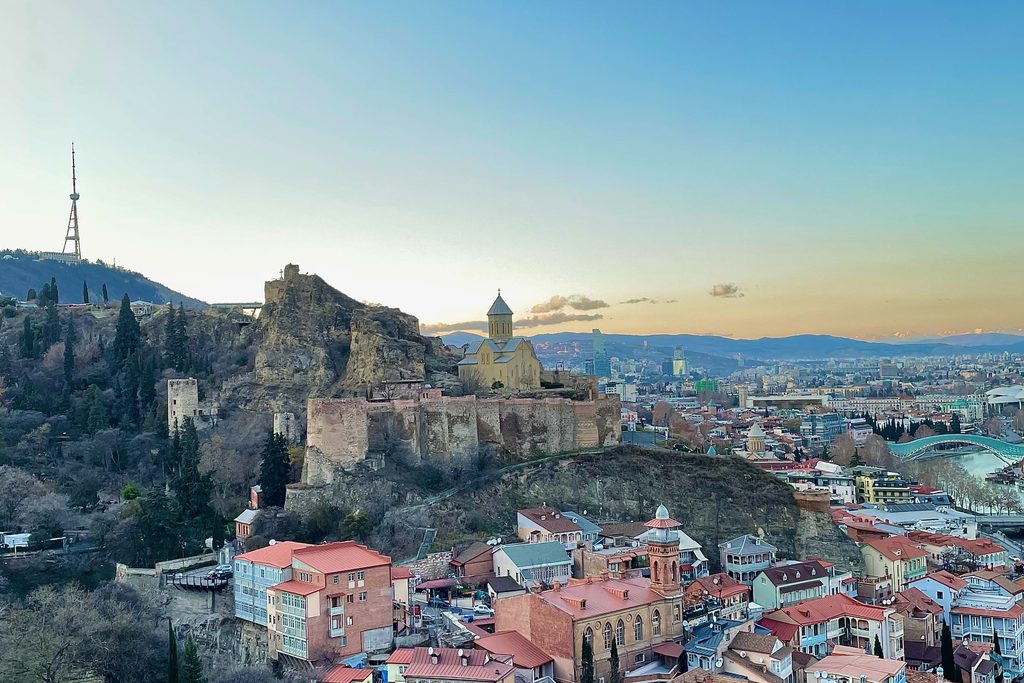
Now, I’m the first to admit I don’t travel for buildings, museums, or history, a heavy day of sightseeing sends me straight to sleep. So it says something that the first thing to really strike me here was how gloriously mismatched Tbilisi looks. Crumbling wooden houses with carved balconies lean beside stark Soviet blocks, and then a glass Bridge of Peace appears out of nowhere.
At first it felt chaotic. Now I love it, and not as some architecture nerd, but because that jumble is the city’s whole personality on display. Tbilisi isn’t trying to look perfect; it’s just being itself, layered up on the old crossroads between Europe and Asia. Even a self-confessed non-sightseer like me happily loses afternoons wandering the Old Town beneath Narikala Fortress, which is exactly the spirit of our week-long Tbilisi itinerary.
The Pace Is Slower Than You Expect
Coming from a fairly fast life back home, the pace here took real adjusting to. Tbilisi is unhurried. People take their time, meals stretch for hours, and a coffee is an event, not a to-go cup. Nobody is rushing you anywhere.
If you’re used to fast-paced cities, this can feel strange for the first day or two. Then it becomes the thing you never want to give up. It’s genuinely part of why so many visitors, me very much included, end up overstaying.
The Food Is Hearty, and Beloved (Even If It’s Not My Thing)
Time for an unpopular local opinion: Georgian cuisine is one of the most raved-about things in Tbilisi, and it’s honestly not for me, I seem to be in a tiny minority on this. But you should absolutely try it, because nearly every visitor I know falls head over heels for it, so don’t let my fussy palate put you off. The staples to sample: khachapuri, the boat-shaped cheese bread with an egg cracked on top; khinkali, juicy soup dumplings you eat by hand (don’t use a fork, you’ll out yourself as a tourist immediately); and generous grilled meats.
The classic thing is to wash it all down with Georgian wine, though wine isn’t my drink at all, I’m a cocktails-and-tequila girl at heart. I’ll brave a shot of the local chacha (a fiery grape brandy) now and then, but I can’t pretend it’s my friend either; a good cocktail wins every time. Either way, a long, toast-filled supra feast is a quintessential Tbilisi night, and worth doing even if, like me, you’re mostly there for the grilled meat and the company. I’m a hopelessly picky eater: not big on bread at all, and, though I genuinely adore cheese on its own, the famous khachapuri still somehow isn’t for me (too much bread, I think). Give me good lamb over either any day.
People Are Direct, But Warm
This one surprised me most. Georgians can seem direct, a little reserved, even blunt at first, and if you’re not ready for it you might read it as coldness. It absolutely isn’t. Hospitality is sacred here; guests are treated as a kind of gift. Once you actually engage, you’ll meet extraordinary warmth, dry humour, and people who’ll go out of their way for you. As someone who is very big on family and loyalty myself, I felt weirdly at home here fast, and it’s a big part of why travellers fall for the city.
The Practical Basics
Here’s what would have saved me some fumbling early on:
- Money. The currency is the Georgian lari (GEL). Cards work in most of the centre, but keep some cash for markets, marshrutkas, and little cafés.
- Getting around. The metro is cheap and simple, marshrutka minibuses go everywhere (and are an adventure), and the Bolt app is dirt cheap and reliable, my default. The centre is very walkable.
- Language. Georgian has its own beautiful alphabet, which looks intimidating and is. English is common with younger people and in tourist areas, and Russian is widely understood.
- When to go. Spring and autumn are ideal; summers are hot, winters cold, though winter opens up incredible nearby skiing.
For up-to-date practical detail, the official Georgia Travel site and reputable guides like Wander-Lush are both solid.
It Feels Safe, But Stay Aware
I’ll be honest: I’m a cautious person, the kind who researches everything twice before trying it, so safety was my biggest worry moving here alone. Tbilisi has genuinely reassured me. It’s considered very safe, I walk home at night in central areas without a second thought, and violent crime against tourists is rare. That said, I still keep normal city sense: watch for the odd pickpocket in crowds, and use the Bolt app rather than unmarked taxis late at night. Once you’ve settled in, the after-dark side, from buzzy nightclubs to the city’s famous techno scene, is well worth exploring, as our Tbilisi nightlife guide covers. I’ve done my research, mind you: the huge, hard-core techno warehouses everyone raves about turned out not to be my scene at all, and I’m not a traditional-bar or beer person either. Give me a proper club, a cocktail, and some shisha going in the corner and I’m perfectly happy.
Frequently Asked Questions
Is Tbilisi good for first-time travellers? Yes. It’s affordable, safe, walkable, and welcoming, with a compact historic centre, famous food, and easy transport, which makes it a very manageable introduction to the Caucasus.
Is Tbilisi safe for tourists? Generally very safe, including at night in central areas. Violent crime against visitors is rare; just use normal big-city awareness against petty theft in crowds.
What should you know before visiting Tbilisi? The currency is the lari, cards are common but carry some cash, the Bolt app makes taxis cheap, and Georgian food and wine are a big part of the experience. Spring and autumn are the best times to visit.
Final Thoughts
Your first impression of Tbilisi probably won’t be what you expected, and honestly, that’s the best part. It’s a city that reveals itself slowly: mismatched, unhurried, generous, and quietly impossible to leave. The longer you stay, the more it makes sense, until one day you realise, as I did, that saying goodbye has become much harder than you ever planned.