

26 June 2024
The towering red dunes of Sossusvlei, deep in the Namib Desert, are the image that sells Namibia to the world. But photographs cannot quite prepare you for the scale, the silence, and the lung-burning effort of climbing them as the sun comes up, and that effort is exactly what draws an adventure addict like me. This is what it is really like to stand on top of one of the highest sand dunes on Earth.
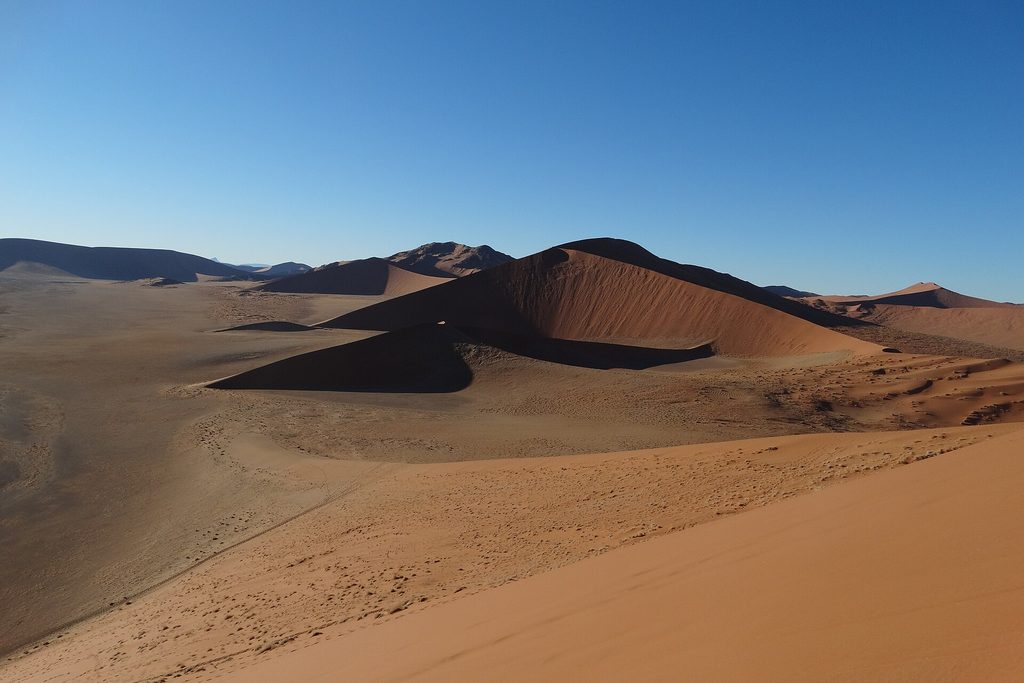
Sossusvlei sits within the Namib-Naukluft Park, part of the Namib Sand Sea, which UNESCO inscribed as a World Heritage Site in 2013. It is the country’s most famous natural attraction, and for many travellers it is the whole reason to come to Namibia.
What Sossusvlei Actually Is
The name Sossusvlei technically refers to a clay-and-salt pan surrounded by enormous star-shaped dunes, at the point where the ephemeral Tsauchab River disappears into the sand. In practice, travellers use “Sossusvlei” to describe the whole area of dunes and pans reached through the Sesriem gate, including the celebrated Dune 45, the vast Big Daddy, and the haunting Deadvlei.
These are among the tallest dunes in the world, some rising over 300 metres, and their deep red colour comes from iron oxide in the ancient sand, exactly the kind of detail the science nerd in me loves. They are also some of the oldest, part of a desert that has existed for millions of years and recognised for its outstanding natural value.
Start Before Dawn
The magic happens at first light. As the low sun climbs, it throws one flank of each dune into deep shadow while lighting the other in glowing orange, and the whole landscape turns molten. That means an early start: you want to be at the Sesriem gate when it opens at sunrise to reach the dunes before both the heat and the crowds.
Staying inside the park, at the Sesriem campsite or Sossus Dune Lodge, buys you a crucial head start, because guests can enter an hour before day visitors. If you are basing yourself outside the gate, plan to be queuing in the dark.
Climbing Dune 45
Dune 45, so named because it stands 45 kilometres from Sesriem, is the most popular dune to climb. At around 85 metres it is not the tallest, but a well-defined ridge gives a natural staircase to the top, and the climb takes most people 30 to 45 minutes.
It is harder than it looks. Walking up a knife-edge of soft sand means every step slides back, and there is nothing to hold on to. Take it slowly, follow the crest, and pause to look back at the view unfolding behind you. The reward at the top is a sea of dunes rolling to the horizon in every direction.
Big Daddy and Deadvlei
For the truly ambitious, Big Daddy is one of the highest climbable dunes in the area, at around 325 metres. The ascent takes roughly an hour and a half in soft, wind-blown sand, and it is genuinely strenuous in the desert sun. The payoff is a spectacular one: you can descend by simply running or sliding straight down the steep face into Deadvlei below.
Deadvlei is the shot everyone recognises. This white clay pan, cut off from water centuries ago, is studded with the blackened skeletons of camelthorn trees estimated to be 600 to 900 years old, preserved by the dry air. The contrast of black trees, white pan, orange dune, and blue sky is surreal, and it is the most photographed spot in Namibia. It is reached on foot across the sand from the 2x4 car park.
Getting Around the Park
The tarred road runs 60 kilometres from the Sesriem gate to the 2x4 parking area. The final five kilometres to Sossusvlei and Deadvlei is deep, soft sand that requires a 4x4. If you are driving a normal car, park at the 2x4 area and take the shuttle for the last stretch, which runs frequently for a small fee.
Whichever dune you choose, come prepared: carry far more water than you think you need, wear sturdy shoes you do not mind filling with sand, and cover your head. The desert is unforgiving once the sun is up, which is exactly why dawn is the time to climb.
Making It Part of a Namibia Trip
Sossusvlei is remote, and most people reach it on a self-drive or guided tour of southern Namibia. It pairs naturally with the coastal town of Swakopmund and the flamingo lagoons of Walvis Bay to the northwest, while most journeys begin or end in the capital, Windhoek. Further south, the quiver tree forest near Keetmanshoop makes another otherworldly stop.
Frequently Asked Questions
What is the best time to visit Sossusvlei? Enter at sunrise for the best light and coolest temperatures. In terms of season, the cooler, drier months from May to October are the most comfortable for climbing.
How tall are the Sossusvlei dunes? Several exceed 300 metres. Big Daddy, one of the tallest climbable dunes, stands around 325 metres; the popular Dune 45 is roughly 85 metres.
Do you need a 4x4 for Sossusvlei? Only for the final five kilometres to Sossusvlei and Deadvlei. A normal car can reach the 2x4 car park, from where a shuttle covers the last soft-sand stretch.
Final Thoughts
Climbing the dunes at Sossusvlei is hard work and utterly worth it. Arrive at dawn, take your time on the ridge, and stand in the silence at the top as the desert glows beneath you, and you will understand why this corner of the Namib is Namibia’s defining sight.