

11 April 2023
Arriving in Swakopmund can feel disorienting. Here, on the edge of the Namib Desert where the dunes tumble into the cold Atlantic, sits a town of half-timbered buildings, German bakeries, and seaside promenades. Palm-lined streets carry names like Bismarck and Kaiser Wilhelm, and the café menus run to apple strudel and black forest cake. It is one of the most unusual towns in Africa, and one of Namibia’s most enjoyable places to break a long desert road trip.
This guide covers where Swakopmund’s strange character comes from, the adventures on its doorstep, and how it fits into a wider Namibian journey.
A German Colonial Time Capsule
Swakopmund was founded in 1892 as the main harbour of German South West Africa, and its colonial architecture is remarkably intact. As South African History Online records, the town grew as Germany’s gateway to the interior, and much of that era survives: the old railway station, the lighthouse, the ornate Woermann House of 1894 with its tower, and rows of colonial villas.
That heritage, combined with the coffee-and-cake café culture and the German still spoken by some residents, is why Swakopmund can feel more like Bavaria than southern Africa. It is worth remembering that this history has a darker side too, as the same colonial period saw grave atrocities against the Herero and Nama peoples, and the town’s museums and monuments reflect that complicated past. You can read the fuller story on the town’s Wikipedia page.
The Adventure Capital of Namibia
The dunes that press right up against Swakopmund have made it Namibia’s undisputed adventure capital. This is the place to break up weeks of driving with a shot of adrenaline, and I never need much persuading:
- Sandboarding down towering dunes, either lying down at speed or standing like a snowboarder.
- Quad biking across the dune belt on guided trails.
- Skydiving, with the jaw-dropping backdrop of the desert meeting the ocean.
- Sea kayaking among seals and dolphins, and scenic flights over the Skeleton Coast, which, as a pilot, was the one activity here I was never going to skip.
Operators cluster in the town centre, and most activities can be booked a day ahead. The Gondwana Collection’s activity guide is a good overview of what is on offer around the town.
Where the Desert Meets the Sea
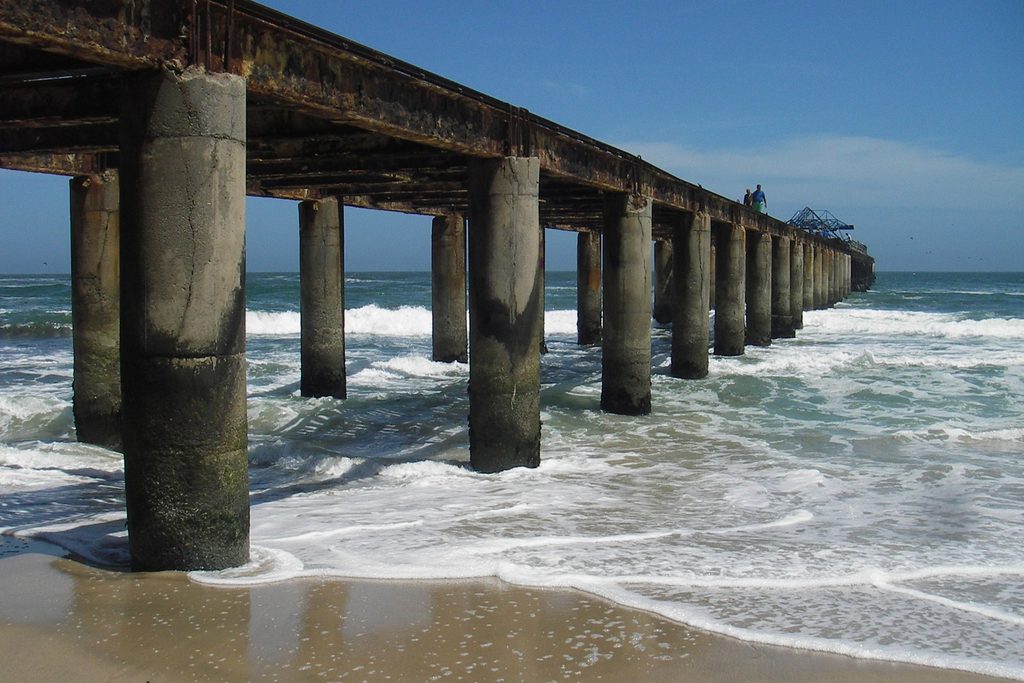
Part of Swakopmund’s appeal is its strange, cool microclimate. The icy Benguela current offshore keeps temperatures mild and often wraps the coast in fog, a startling contrast to the furnace of the interior. A stroll out along the historic jetty or around the Mole breakwater, with the salt breeze and the sound of the surf, is the classic way to feel it.
Just down the coast lies Walvis Bay, whose lagoon draws thousands of flamingos, and beyond it the towering dunes of Sandwich Harbour, where the sand plunges straight into the ocean on one of the region’s most dramatic 4x4 excursions. Fresh Atlantic seafood, including oysters farmed in the cold, clean water, rounds out a stay, for everyone but me, that is, since seafood is my one great culinary blind spot. For more on the birdlife and boat trips next door, see our guide to where to see flamingos at Walvis Bay.
Fitting Swakopmund Into a Namibia Trip
Swakopmund is the natural coastal hub of a Namibian road trip, and most itineraries build in a night or two here to rest, refuel, and play. It pairs beautifully with the red dunes of Sossusvlei to the south and the colonial port of Lüderitz further down the coast, while journeys typically begin or end in the capital, Windhoek, about a four-hour drive inland. The African Budget Safaris guide is a handy primer on logistics.
Frequently Asked Questions
Why does Swakopmund look German? It was founded in 1892 as the main harbour of German South West Africa, and its well-preserved colonial architecture and café culture survive from that era.
What is Swakopmund known for? Its German colonial buildings and its role as Namibia’s adventure capital, offering sandboarding, quad biking, skydiving, and kayaking, all where the Namib dunes meet the Atlantic.
How far is Swakopmund from Windhoek? Roughly 350 kilometres, about a four-hour drive across the desert on a good tarred road.
Final Thoughts
Swakopmund is one of those places that should not quite make sense and yet completely works. Part German town, part desert adventure base, part chilly seaside resort, it is the perfect place to catch your breath in the middle of a Namibian journey, before the dunes and the open road pull you onward again.