

08 December 2022
Walk down one street in central Sarajevo and something strange happens. The Ottoman bazaar of low wooden shops and copper stalls gives way, almost mid-stride, to grand Austro-Hungarian facades that could belong in Vienna. There is even a line set into the pavement marking the exact spot. I travel with my nose buried in the history of a place, and few cities wear theirs as openly as this, which is exactly why Sarajevo can feel like two cities in one.
This guide explains the meeting of cultures that defines Sarajevo, and where to experience both sides of the city.
The Meeting of Two Empires
Sarajevo spent centuries under Ottoman rule before the Austro-Hungarians took over in the late nineteenth century. Each left its architecture, its religion, and its rhythms, and the city never chose between them; it simply layered one on top of the other. The result is a place often called the “Jerusalem of Europe,” where a mosque, an Orthodox church, a Catholic cathedral, and a synagogue all stand within a few minutes’ walk.
Where the Line Is Drawn
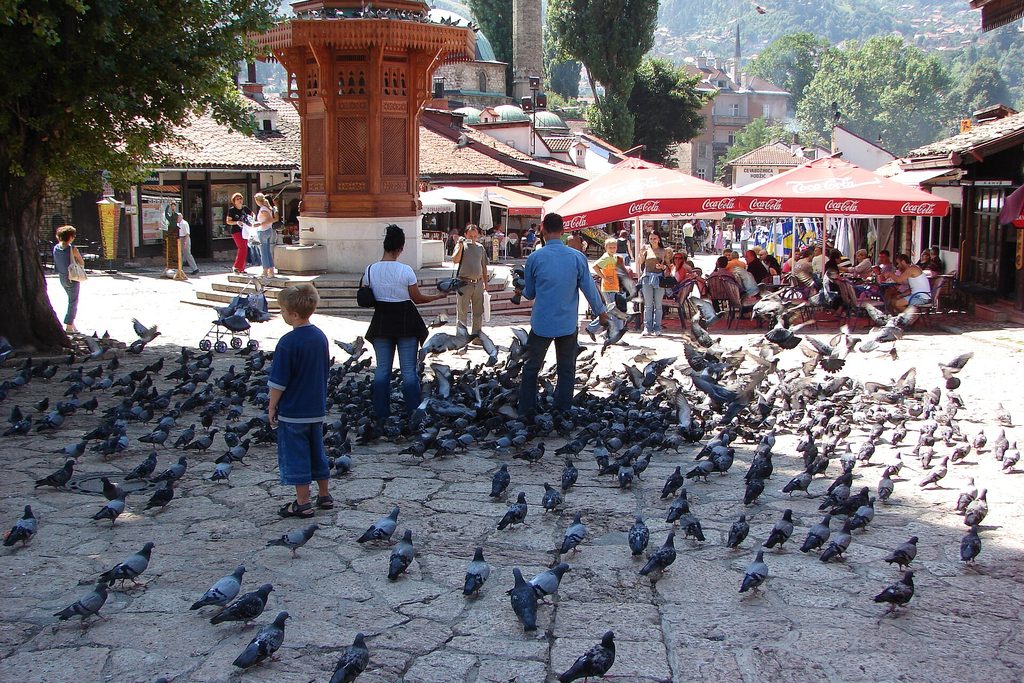
The point where the two worlds meet is literally marked on Ferhadija Street as the “Sarajevo Meeting of Cultures,” a plaque with arrows pointing east and west. Look down and you’ll even see the paving change colour, and the architecture flips with it. On the eastern side lies the Ottoman world of Baščaršija, the 15th-century bazaar where coppersmiths still hammer trays, the Sebilj fountain draws pigeons, and grilled ćevapi scents the lanes. To the west, neat blocks of neo-Renaissance mansions and Art Nouveau buildings, the Sarajevo Cathedral, and European cafés.
Understanding the Recent History
Sarajevo’s story did not end with the empires. This is where the shot that sparked the First World War was fired, at the Latin Bridge, and standing on that unremarkable spot, after years of reading about it, genuinely gave me chills; you can trace the event on the bridge’s Wikipedia page. And the scars of the 1990s siege are still visible if you look, in pockmarked facades and the red-resin “Sarajevo Roses” that mark where shells fell. The Tunnel of Hope museum and the markers around the city help make sense of those years, and they add a sobering, essential layer to any visit.
Eating Between the Two Worlds
Sarajevo’s food mirrors its split personality, and it is gloriously cheap. On the Ottoman side, try ćevapi with fresh somun bread, little grilled-meat fingers that were right up my street, burek from a bakery, and thick Bosnian coffee served with a cube of sugar and rahat lokum. Climb to the Yellow Fortress at sunset for a sweeping view over the minarets and rooftops as the call to prayer echoes across the valley.
Frequently Asked Questions
Why is Sarajevo called the place where East meets West? Because it sits on the historic line between the Ottoman (Islamic, eastern) and Austro-Hungarian (Christian, western) worlds, visible in a single street where the architecture, and even the paving, changes from one to the other.
What is Baščaršija? Baščaršija is Sarajevo’s 15th-century Ottoman bazaar and historic heart, full of coppersmiths, cafés, the Sebilj fountain, and the aroma of grilled ćevapi.
Is Sarajevo worth visiting? Very much so. It is affordable, welcoming, and uniquely layered, blending Ottoman and Austro-Hungarian heritage with a moving recent history, all in a walkable, beautiful setting.
Final Thoughts
Sarajevo is not on the border of East and West so much as built directly on top of it. That double identity, visible in a single street, is exactly what makes it so fascinating. Give it a weekend, and pair it with a sobering day at Srebrenica or the nightlife of nearby Belgrade as part of a wider Balkan road trip.